
Nonprofit Data & Systems Strategy
Build a Data Strategy
Your Nonprofit Can Actually Execute
A practical guide for nonprofit executives who want answers in the room, not a week later.
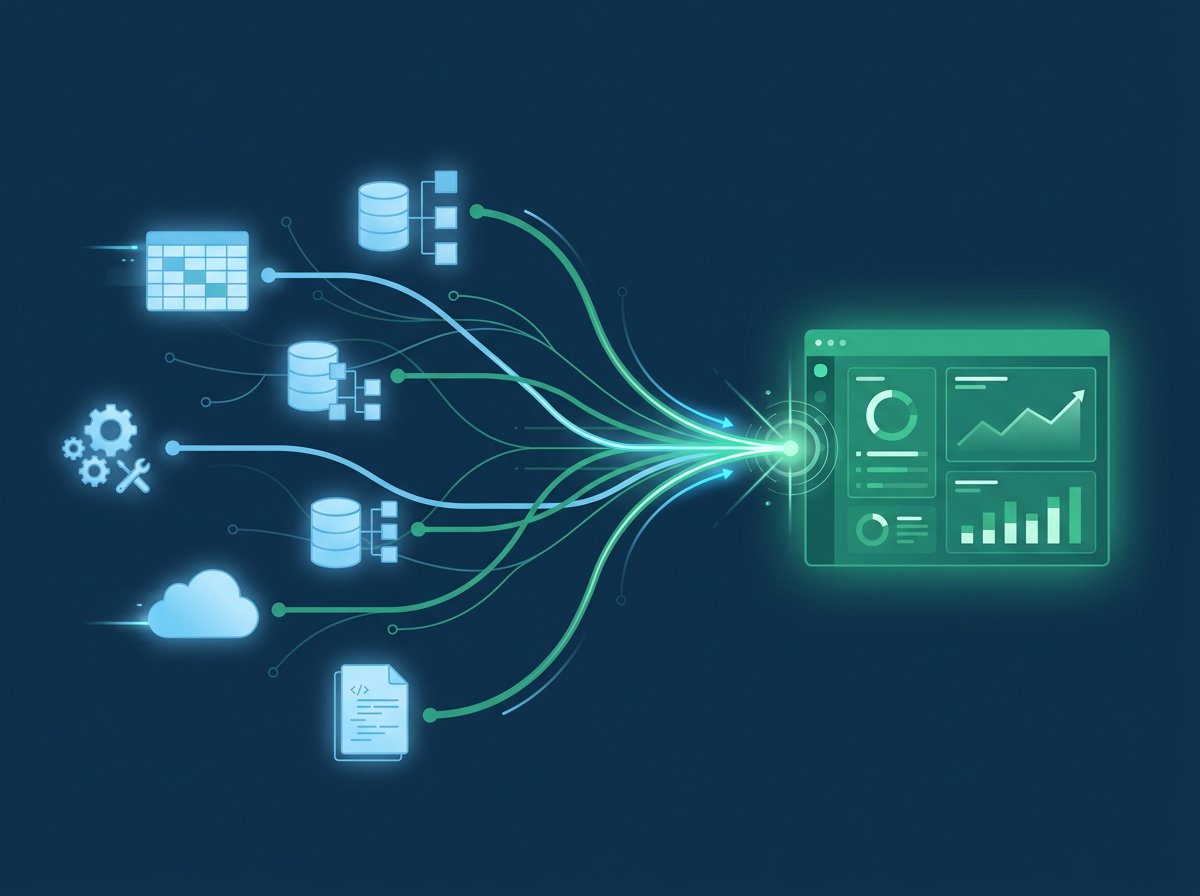
You're an Executive Director in a funder meeting and someone asks a question: Can you predict the number of chronically homeless individuals you will be able to provide 80% or more of your services to in the metro Boston region?
You open up your computer, pull up your BI (Business Intelligence) reporting tool, and ask the question. A report is generated detailing rollup data for the last five years. You then ask for a prediction based on existing enrollment and legal changes. The answer is returned within moments. You are able to drill down into the services data, identifying exactly which services constitute that percentage.
The funder asks a follow-up question, this time focusing on age-range statistics compared against the average age ranges for chronically homeless individuals in metro Boston and beyond. You can answer this question too.
Does this feel like a fairy tale?
In a Perfect World: Your Nonprofit Data & Systems Strategy
You start your nonprofit. You know what questions you need answered. You know what success looks like. You understand your nonprofit data strategy before you buy a single tool.
You need systems that will help you run the organization. You're crystal clear on the layers you'll need - your nonprofit tech stack - and they look like this:
- User Interaction Tools: Where people engage with you and share their information. Apps, website, portal, chatbots, all increasingly AI-powered. Also includes how you engage with them: emails, SMS, phone outreach.
- System of Record: Where your customer history lives. This is your CRM strategy foundation - the donor database, association management database, or case management system that holds your constituent data.
- Payment and Billing: Where financial transactions are processed before reaching your books.
- Financials: Your books.
- BI and Reporting: The reporting you need to run your organization.
- Data Warehouse: An aggregation layer where data from multiple systems lands for cross-system analysis. Most small and mid-sized nonprofits do not need this. When you do, you will know it.
You go shopping and find the perfect system that does it all. Or perhaps it's several systems and they all communicate seamlessly with one another. Your nonprofit system integration happens cleanly, with clear data ownership and automated workflows.
When you ask your BI tool for an intelligence report, it pulls information from all systems as needed to give you the complete picture.
You live happily ever after serving your clients. The end.
In Our World: When Data & Systems Strategy Goes Wrong
Your nonprofit has been operating for almost two decades, or perhaps six. Your service portfolio and reach have changed dramatically over that time. As you've grown, you've added systems to help you manage the data, interactions, everything you need to run your organization and support your constituents.
You've outgrown systems and added new ones. You've customized others to help you meet new requirements from your funders, donors, and constituents. You have thousands, tens of thousands, or hundreds of thousands of rows of data spread across all of these systems. Most of them don't talk to each other. Your staff moves data between them manually or with fragile integrations.
When you have a question, you send it to your data team. A week later, well past the funder deadline, you receive a spreadsheet with incomplete answers and a note that the predictions are statistically highly variable.
You go into a board meeting and the new board president says the answer is a new CRM. That is what will generate the reports you need. Salesforce Nonprofit Success Pack, perhaps. Everyone nods. You've had this conversation for five years running. This time, it looks like a budget might be approved for next fiscal year. You ask your data team to set up a demo.
The demo is impressive. The platform is capable. The implementation estimate comes back at twice what you budgeted, with a timeline that assumes staff bandwidth your team does not have. The board approves it anyway. Eighteen months later, your team is managing a new system and your staff is still pulling reports manually and delivering them, a week late. You are nowhere near your fairy tale ending.
This Is Not A Technology Failure. It Is a Strategy Failure.
The problem is not the technology. It's that a nonprofit data strategy was never built before the demo was scheduled.
There were questions that needed to be answered first. At a high level, the most important ones are:
- What does your organization actually need to know, and when? (This drives your nonprofit CRM strategy, your reporting requirements, and your entire nonprofit tech stack.)
- Who will own this system not just at launch, but two years from now, when the person who ran the implementation has moved on?
- What does clean data mean for your specific constituent base, your program mix, your reporting requirements?
- What are you willing to give up? Every platform involves trade-offs, and pretending otherwise is how you end up surprised by them.
These are not questions a vendor can answer. They must be worked through before any vendor enters the room. That's nonprofit data strategy.
What Coat Rack Does
Coat Rack is not a CRM vendor. We are not a Salesforce partner or reseller. We have no stake in which platforms your organization chooses.
We are the partner who builds your nonprofit data strategy before the demo. We help organizations clarify what they actually need to know, design a nonprofit tech stack that supports it, plan your nonprofit system integration, and define success before any contract is signed.
Some organizations come to us before a major CRM strategy decision, needing help with evaluation, selection, and implementation planning. Others come to us after the decision has already been made, needing help getting more from what they have built. We do both.
The Executive Director in the funder meeting at the top of this page is not there because they bought the right CRM. They are there because someone helped them think clearly about what they needed to know before any platform decision was made, built a nonprofit data strategy around those answers, and then established governance to sustain it.
That is the work. It takes far longer than a demo cycle. And it is the only path to the fairy tale.
Is your organization
facing a major CRM or data strategy decision?
Do you want a clear-headed conversation before the vendor demos begin?
Let's talk.