
Nonprofit Data & Systems Strategy
CRM vs. BI Tool vs. Engagement Layer vs. Data Warehouse
What Each One Is Actually For: A Nonprofit Tech Stack Primer
Stop confusing these systems. Here's what each one actually does - and which ones you actually need.
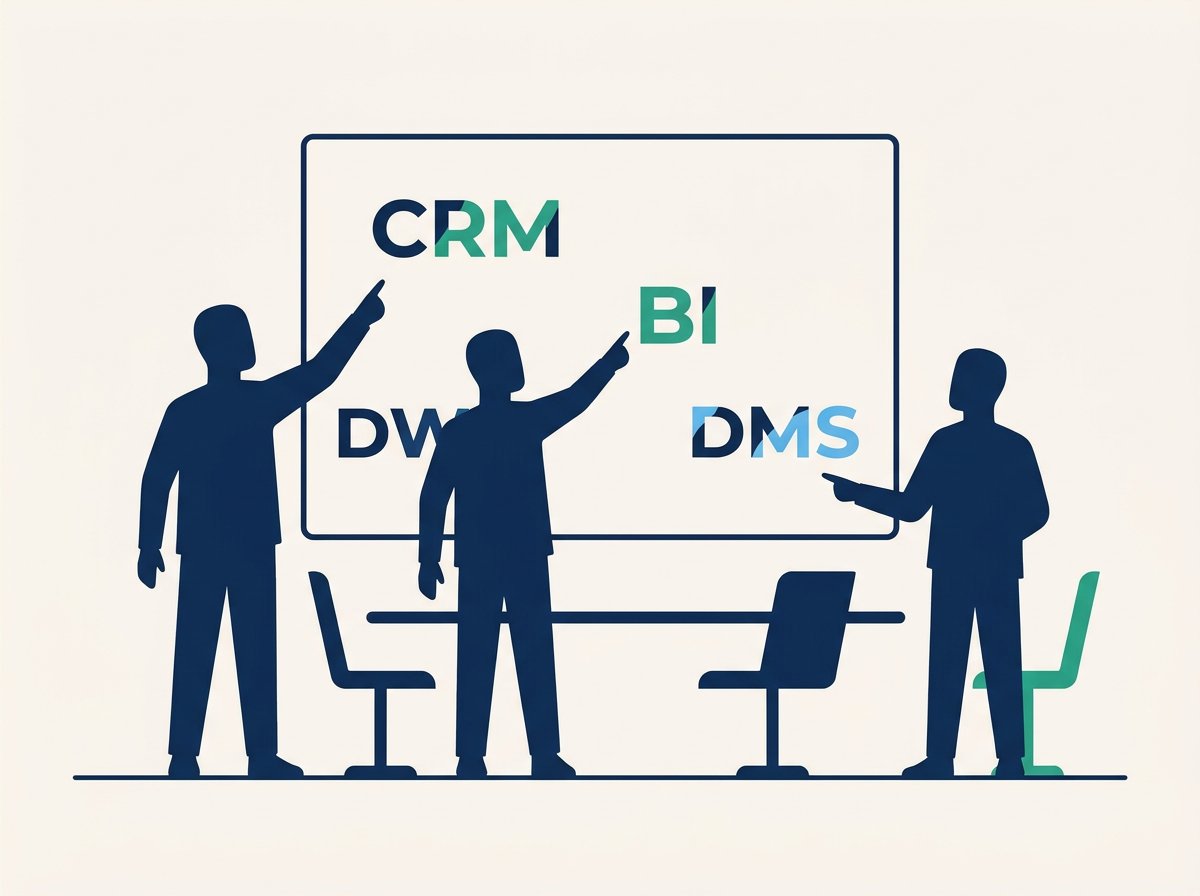
Too many acronyms.
You're a nonprofit ED. Why do you care about all these acronyms? Isn't that your IT person's job?
You're in a meeting. Someone says, "We need to upgrade our DMS to a CRM." Someone else says "Actually, we need an engagement layer." A third person says "Or maybe we should build a data warehouse."
Nobody is exactly sure what the difference is, or which one solves which problem. And that's the core problem with most nonprofit tech stacks: the layers aren't clear.
This confusion is expensive. It leads organizations to buy tools they don't need. It leads them to skip tools they actually do need. It leads them to implement the right tool in the wrong way.
These systems do fundamentally different jobs. Understanding what each one is for - and how they fit together in your nonprofit tech stack layers - changes everything about how you build your data infrastructure.
The CRM / DMS / AMS: Your Systems of Record
Who moves through your organization?
You probably have donors.
You possibly have clients you need to track information about.
Maybe you're an association with members.
Donors = DMS (Donor Management System)
Clients = CRM (Client Relationship Management)
Members = AMS (Association Management System)
All of these are "systems of record" in your nonprofit tech stack. It's where you store information about the people you work with: clients, donors, members, volunteers, whoever moves through your organization.
Lots of volunteers to schedule and manage? Yup. Those go in a VMS (Volunteer Management System). Grant management? GMS (Grant Management System). These are all part of your nonprofit tech stack layers.
These systems are transactional. They capture people, interactions, donations, services received; the ongoing, day-to-day log of what's happening.
They enforce consistency. You define what a "client" or a "donor" is, and the system enforces that definition. You define the fields you need, and the system collects them the same way every time.
But here's what these systems are not designed to do: answer analytical questions quickly. This is where the nonprofit CRM vs BI debate becomes critical.
You cannot ask your CRM "what was our revenue trend last year by program" and get an answer in two minutes. Someone has to navigate the system(s), pull the data, filter it, aggregate it, reshape it.
That's a different job. That's where the BI tool comes in - and why understanding nonprofit CRM vs BI is essential to your nonprofit tech stack.
The BI Tool: Where Nonprofits Ask Real Questions
A BI tool (Business Intelligence - tools like Tableau, Metabase, Power BI, or Looker) is built specifically to answer analytical questions fast. It connects to your system(s) of record and other data sources, then turns that data into dashboards and reports.
This is the critical layer in your nonprofit tech stack layers that most nonprofits are missing.
It's not transactional. You're not entering data into it. You're not running your day-to-day work through it. It's read-only, it just sits there, with data flowing in from your systems, ready to answer questions.
A BI tool can reshape data, aggregate it, compare it across time periods, break numbers down by program, geography, demographic, or funding source, all in seconds.
When you're evaluating nonprofit CRM vs BI, understand this: your CRM is not a reporting tool. A BI tool is. They serve different purposes in your nonprofit tech stack layers.
Your BI tool is a reporting specialist. That's why it's fast. This is the layer most nonprofits are missing in their nonprofit tech stack.
The Engagement Layer: Where Your Constituents Interact
This is the interface your constituents see: a client portal, a donor dashboard, a volunteer signup system, a chatbot, a mobile app. Sometimes it's built into your CRM/DMS. Often it's a separate tool that connects.
The engagement layer is external. It needs to be simple and intuitive. It's usually web or mobile-based, and increasingly powered by AI.
The engagement layer doesn't replace a system of record. It works with it. When a client logs in to check on their case, that interaction gets recorded in the CRM. When a donor sees their giving history, the DMS is feeding that data to the portal.
Understanding how your engagement layer fits into your overall nonprofit tech stack layers is crucial for a smooth user experience.
The Data Warehouse (DW): When You Need It
A data warehouse is an aggregation layer that combines data from multiple systems into one place.
Most nonprofits don't need one. The signal that you do is when your team regularly has to pull reports from three different systems and stitch them together in a spreadsheet.
If you have a solid system of record and a BI tool connected to it, that solves most reporting problems in your nonprofit tech stack. Don't buy advanced infrastructure until you've proven you need it.
Your Nonprofit Tech Stack Layers: What Actually Matters
Understanding nonprofit CRM vs BI, and where the engagement layer and data warehouse fit, is how you build an infrastructure that actually works.
Most nonprofits get this wrong because they think about the systems themselves instead of thinking about the layers: system of record → BI tool → engagement layer → (optionally) data warehouse.
Get those layers right, and nonprofit CRM vs BI becomes clear. Get them wrong, and you're buying expensive tools that can't talk to each other.
"The real win isn't knowing what these nonprofit tech stack layers are called. It's knowing which ones you're missing, and which ones you're wasting money on."
Ready to understand what your nonprofit tech stack layers actually need?
Or download our Data Health Audit to assess where your nonprofit tech stack layers stand right now.