July 20, 2026
 A Beijing-based startup called Moonshot AI just released a new model called Kimi K3. In blind tests, developers preferred it over the newest models from Anthropic and OpenAI for front-end coding tasks. It costs 40% less to run. And Moonshot released the model weights publicly, meaning any organization can download Kimi K3, run it on their own servers, and use it without paying per token.
This is real news. And for nonprofits watching their budgets, it sounds like exactly the kind of break they've been waiting for.
Is it, though?
The promise sounds like independence. Two promises, actually.
The case for self-hosted open-weight models is more compelling than it looks at first, because it makes two separate arguments at once.
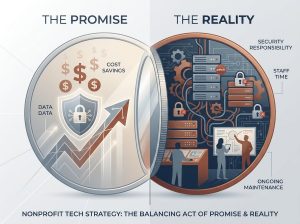
Promise 1: Cost savings. Download the model, run it on your own infrastructure, and you're free. No more paying OpenAI or Anthropic every time a staff member asks a question. You control the costs. For a nonprofit running on thin margins, that framing is genuinely appealing.
Promise 2: Data privacy. Your donor data stays on your servers. Foster care case files, domestic violence client records, housing applications. These are not data you want traveling through third-party infrastructure carelessly, and self-hosting promises a way out of that concern.
Both promises are real. And both are more complicated than they look.
On cost: the savings only materialize if the operational overhead of self-hosting doesn't exceed what you were spending on managed tools. (More on that below.)
On privacy: "on your servers" is not a synonym for "secure." It means you are now responsible for the full security posture: patching the OS and model runtime when vulnerabilities are found, running regular backups and actually testing them, maintaining compliance documentation for any applicable regulations, and handling incident response when something goes wrong. For many nonprofits, outsourcing to a vendor with dedicated security infrastructure is actually the safer choice, not the riskier one. A well-run SaaS AI provider has a security team. Most nonprofits with 15 to 50 staff do not.
You're not becoming independent. You're swapping dependencies.
Every piece of technology your organization relies on creates a dependency. The honest question isn't whether open-weight models eliminate yours. It's which dependencies you're trading away and which ones you're taking on.
When you self-host an open-weight model like Kimi K3, here is what you are now depending on:
Moonshot AI continuing to compete and advance the model. If they stop, you're stuck with whatever version you downloaded. Open weights are a snapshot, not a subscription to ongoing improvement.
Product companies building usable tools for your specific use cases on top of that model. Here's the part that gets glossed over: most nonprofits don't interact with a raw model. They use a product built on top of one. CRM integrations, grant writing assistants, program reporting tools. Right now, most of those products for nonprofits are built on top of managed APIs. Some will pivot to open models. Others will support both. But either way, you're still buying the product. The model being free does not mean the thing your staff actually opens and uses is free. You're paying for the product layer regardless of what sits underneath it.
Your own cloud infrastructure staying reliable and secure. That means AWS or equivalent, configured correctly, monitored, and maintained.
Someone on staff (or a contractor you pay) who can deploy, maintain, and integrate this stack. That is not a small ask.
Your own team handling security patches, data backups, compliance audits, and disaster recovery.
None of those dependencies disappear with a managed AI tool like what you're already using. They just look different. With managed tools, a vendor carries the infrastructure, security, and integration work. You pay for that through your subscription. The question is not which approach is cheaper in isolation. It's which set of dependencies your organization can actually absorb without pulling focus from your mission.
A practical framework for your size
If your budget is under $5 million or your tech capacity is limited to someone who wears three other hats: pay for managed AI tools. Your staff time is worth more than the per-token savings, and the operational overhead of self-hosting is not trivial.
If you're between $5 million and $15 million with a part-time technology person: self-hosting is worth exploring, but only if that person has genuine bandwidth to own and maintain it. If they're already at capacity, this adds to the pile rather than simplifying it.
If you're above $15 million with dedicated technical staff: this deserves a serious evaluation. But even then, run the full dependency audit before you commit. What happens when the model needs a security patch and your tech lead is on vacation? What's your rollback plan?
What this means for nonprofit technology decisions
The trajectory here is real. Open-weight models are getting better quickly. The tooling built on top of them will improve. The case for self-hosting will grow stronger over the next few years, and organizations that understand the landscape now will be better positioned to make the move when it actually makes sense for their capacity.
But "the technology is improving" is not the same as "this is the right move for your organization today."
In my conversations with nonprofit leaders, the topic isn't which AI model is winning this month. Those rankings change every few weeks. The conversation is about what your organization is actually signing up for, whether your team can carry it, and how to make technology decisions that hold up over time instead of chasing whatever looks promising in the moment.
The goal is not to find the shiniest tool. It's to find the right dependencies, understand the ones you're taking on, and make sure they fit your capacity to serve your mission.
Open-weight models are coming. The question is whether they're coming for you... yet.
About Coat Rack: We're a nonprofit technology strategy firm helping mission-driven organizations reduce tech chaos and build future-ready technology plans. We serve as the dedicated tech strategist that most nonprofits don't have at the leadership table.