October 10, 2026

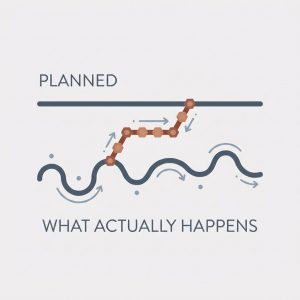
The gap between what you planned and what actually happens is where chaos lives.
You've seen it play out. An organization builds a thoughtful roadmap: upgrade the database in Q2, implement a new CRM in Q3, migrate email in Q4. The plan looks solid. Leadership agrees. Everyone moves forward with confidence.
Then Q2 arrives. A key grant falls through. Two team members leave. A crisis in program delivery pulls resources away. The carefully crafted roadmap becomes a relic gathering dust in a Google Doc. By Q4, nobody is sure what was supposed to happen.
This is the most common gap we see between nonprofit strategy and reality: the roadmap gets built, but nobody plans for the moment the real world collides with it. So it becomes just a to-do list, a static checklist that nobody looks at once circumstances change.
A roadmap that fails is usually not a bad roadmap. It's a roadmap being used wrong.
The Roadmap's Real Job
A tech roadmap should not be a timeline of projects to check off. It's a continuous feedback loop: the leadership tool that keeps your strategy and your reality aligned.
In a healthy organization, you set a strategic direction and start moving. Three months in, something shifts. Maybe it's external: a funder wants to see new capabilities. Maybe it's internal: you've learned something about your actual capacity, or priorities have changed based on what's working. A strong roadmap doesn't ignore these changes. It's where you reality-check your direction and make intentional adjustments before money and momentum are wasted.
The teams that do this well build what we call alignment checkpoints into their roadmap work.
Alignment Checkpoints: The Rhythm of Real Adjustment
An alignment checkpoint is a scheduled moment, usually quarterly or semi-annually, when leadership gathers to look at three things.
What was supposed to happen versus what actually happened? No blame, just honesty. If you planned to have a new reporting dashboard by now and you don't, why? Did capacity get pulled elsewhere? Did the dashboard turn out to be less valuable than you thought? Did the requirements keep shifting? Name it.
What's changed since we last looked? What's different about the organization's needs, capacity, external environment, or priorities? What do you know now that you didn't know when you built the roadmap? This is where real leadership happens: you're not defending the old plan, you're responding to new information.
Given all of that, what should we do differently? Scrapping everything is rarely the answer. Ask instead: should we reorder? Pause this to make room for that? Descope a project to make it achievable? These decisions get made at the checkpoint, not in a panic when reality forces your hand.
After that conversation, the roadmap gets updated. Everyone knows the new priorities, and the roadmap becomes trustworthy again because it reflects what you're actually doing.
Organizations that skip this step expect the roadmap to survive unchanged for 12 months. It won't. Organizations that succeed expect it to evolve as they learn.
Why This Matters (Beyond Not Wasting Money)
We see a pattern constantly: an organization builds a roadmap, something changes, and they either ignore the change (and spend resources on work that's no longer the priority) or abandon the roadmap altogether (and slip into reactive chaos). Alignment checkpoints prevent both. Here's why they work:
They create a shared reality. When everyone sits down quarterly to compare what happened with what was planned, the ED, the COO, and the tech team are all working from the same facts. Shared reality is the foundation for smart decisions.
They reduce waste. A roadmap nobody trusts gets ignored, then replaced by a dozen smaller, conflicting priorities. People scramble, and you end up paying for work that later gets scrapped, because it doesn't align with where the organization actually went. Checkpoints force the conversation before the waste happens.
They position tech as strategic, not just responsive. When technology decisions are made on the fly ("what broke today," "what did someone request?"), tech is the cost center. When you intentionally adjust a roadmap in line with your strategy, tech becomes a lever for achieving your mission. That's a completely different conversation to have with your board and funders.
They create capacity for real governance. Many nonprofits never address tech strategy at the board or leadership level because the conversation is too chaotic. Checkpoints provide the structure. Suddenly you can ask, "What does our tech foundation look like in five years?" because you're not drowning in tactical surprises.
Building Your Roadmap to Support This
A few structural things matter if you want checkpoints to stick.
Make the roadmap a document people return to. Not a PDF emailed once, but a living document covering the current quarter and the next two in enough detail to matter: what you're doing, why, when, and what depends on what. Too abstract ("improve our tech") is useless: too detailed (every single task) is a burden to update. Aim for outcomes and initiatives, not individual tasks.
Give it one owner. Usually this is your head of tech or a strategic operations person. Who it is matters less than the fact that someone owns the new version after each checkpoint. If everybody kind of owns it, it won't get updated.
Schedule the checkpoint and make it non-negotiable. You can't get to it "when things slow down," because things never slow down. Put it on the calendar every quarter, allow at least two hours, and bring the right people: at minimum, the ED and whoever owns tech.
Separate the roadmap conversation from the budget conversation. The roadmap is about priorities and timing; the budget is about what you can afford. Mix them in one meeting and one always loses. Hold the roadmap checkpoint in March and the budget review in May, or whatever timing suits your organization.
Where to Start
If your roadmap is gathering dust, the smallest next step is a single alignment checkpoint. Bring together your ED, anyone who oversees tech, and anyone who feels impact from tech decisions. Ask three questions:
- What did we say we'd do with tech this year?
- What actually happened, and what's different from what we expected?
- Given what we know now, what should we do in the next six months?
You don't need a fancy template or a perfect process. You need one real conversation. See how it feels. See what changes. Most organizations find it clarifies enough that they want to make it a regular rhythm.
If you want a structured way to build that in, our Nonprofit Tech Strategy Blueprint is designed for exactly that. Over six weeks, we audit your current state, build a roadmap grounded in your reality, and set up the governance rhythms that keep it honest. The result is a board-ready tech strategy and a team that knows what you're building and why.
If you're further along and want a tech strategist at your table each quarter to reality-check priorities and facilitate those alignment conversations, that's our Mission-Driven Tech Strategy Retainer: a year-long partnership in which we're your outside perspective and your honest voice when it's time to adjust.
Either way, the shift happens when you stop treating the roadmap as a to-do list and start treating it as the continuous feedback loop it is.
Your tech strategy deserves to evolve as you learn.
Ready to build a roadmap that actually works? Start with the Blueprint - six weeks to a board-ready tech strategy and the governance practice to keep it alive.
Or if you'd like to explore a longer-term partnership where we help you navigate strategy decisions as they come up, let's talk about the Retainer. You can schedule a quick call here to discuss what would work best for your organization.