September 10, 2026
A CEO of a nonprofit sat across from me and started listing her tech problems.
"We have projects that aren't connected to each other," she said. "Some work for one department, but not across the organization. We have projects that are siloed and unfunded and not succeeding. And we don't have one place where leadership can actually say, 'What should we prioritize over something else?'"
She paused.
"Do we need a technology roadmap? Or are we just bad at execution?"
That question comes up a lot. And the answer is usually: both. But not in the way she was thinking.
The Question Nobody Wants to Ask
Most nonprofits don't think they need a roadmap.
They think they need better execution. Faster decisions. A better team. A new tool.
But here's what actually happens: They buy the new tool. They hire the better team. They make the decisions faster. And the problem stays the same.
Because the problem isn't execution. The problem is that nobody has mapped out what "success" actually looks like across the organization.
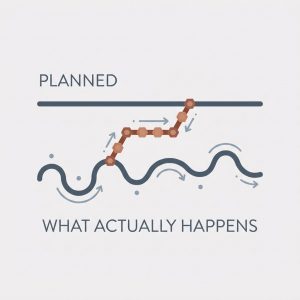
Without a roadmap, you're not executing badly. You're executing in different directions.
What Happens When You Skip the Roadmap
Let's look at what this CEO was actually describing.
Siloed projects that aren't connected. Team A built something that works for their department. Team B built something that works for theirs. But they don't talk to each other. So a customer who touches both teams has to enter data twice, or data doesn't flow between systems, or the two teams keep duplicating work because they don't know what the other one is doing.
Without a roadmap, there's no place to ask: What's the full customer journey? Which teams touch it? How should these systems work together?
Unfunded projects that aren't succeeding. Someone has a great idea. Leadership says yes. But there's no real plan for what it costs, what resources it needs, or what success looks like. So it limps along, half-done, consuming energy without delivering value.
Without a roadmap, there's no mechanism to ask: Is this worth doing? What would it actually take? What comes first? Are there other resources in our organization that can help this project?
No place for leadership to prioritize. Every request sounds important. Every problem feels urgent. The board wants innovation. The CFO wants cost reduction. The program team wants better reporting. So everything gets done a little, and nothing gets done well.
Without a roadmap, leadership can't say: Here's what we're doing this year. Here's what comes next. Here's why.
That's not a tech problem. That's a roadmap problem.
Three Signs You Probably Need One
If you're sitting in your nonprofit thinking "That sounds like us," here are three clear signs:
Sign 1: You replaced the tool, and you're not sure if it helped.
You bought the new CRM. You finished the implementation. Six months later... did it work?
You're not sure.
Some staff still use spreadsheets. Reporting is better in some departments, messier in others. And nobody has a clear way to answer: Is this actually working? For whom? Against what metric?
This happens because there's no org-wide, strategic way to measure success. Each department has different definitions. Some care about speed. Some care about accuracy. Some care about adoption. Without a roadmap that defines outcomes upfront, you can't tell if the new tool is solving the problem or just moving it around.
A roadmap isn't about picking the right tool. It's about defining what success looks like before you pick it, so you can actually measure whether it worked.
Sign 2: "Small changes" keep becoming surprise projects.
Someone asks for a simple thing. A dashboard. A form tweak. A new report. Then it turns out the dashboard needs data that doesn't exist yet. The form tweak affects five other workflows. The report requires a data cleanup nobody budgeted for.
This happens because nobody mapped the dependencies. Without a roadmap, small changes surprise you because you can't see all the systems they touch.
Sign 3: Leadership can't agree on what matters.
Every request has a compelling story. Every project sounds urgent. The loudest voice wins. Or the closest deadline wins. Or whoever is most frustrated wins.
This happens because there's no shared way to evaluate what actually matters to the mission. Without a roadmap, priorities shift every month, and the team stops believing technology decisions mean anything.
The Roadmap Isn't About Being Organized
Here's the thing: The CEO I mentioned at the top wasn't bad at execution. Her team was solid. The problem was that she didn't have one place to answer this question:
Given everything we're trying to do, what should we actually focus on first?
A technology roadmap doesn't mean you have to be perfectly organized. It doesn't mean you need to plan five years in advance. It doesn't mean bureaucracy.
A technology roadmap is just: Here's what we're doing this year. Here's why. Here's what comes next.
Rinse and repeat every quarter, because things change.
It's the difference between reacting to every request and actually choosing what matters.
If This Sounds Like You
If you're seeing patterns like siloed projects, unfunded initiatives, or leadership confusion about priorities, the problem isn't usually bad execution.
It's the absence of a clear structure for deciding what to do.
That structure is what a technology roadmap provides.
And if you want to know whether a roadmap is actually the right move for your nonprofit, we've identified nine specific signs that point to a roadmap being necessary.
Some are obvious. Some are subtle. But if you're recognizing several of them, you're probably in a situation where a roadmap would help.
See all nine signs your nonprofit needs a technology roadmap